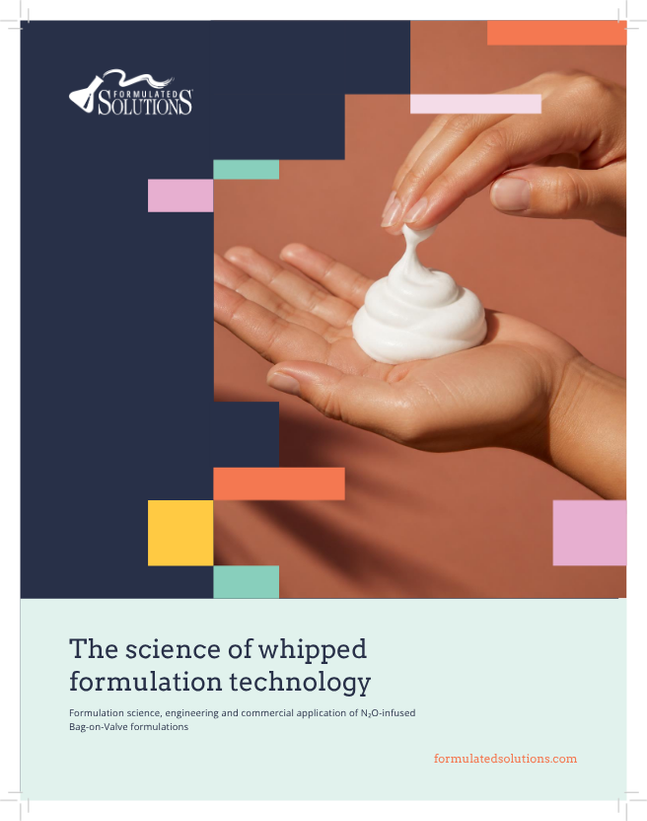
The science of whipped formulation technology
How the eN₂fused™ platform turns a conventional lotion, cream or ointment into a light, structured whip — by infusing the formula itself with nitrous oxide microbubbles and dispensing it from a compressed-air Bag-on-Valve package.
Executive summary
Whipped formulation technology turns a conventional lotion, cream or ointment into a light, structured foam that spreads into a smooth film on contact with skin. Formulated Solutions’ eN₂fused™ platform achieves this by infusing the formulation with nitrous oxide (N₂O) microbubbles and dispensing it from a Bag-on-Valve (BoV) package driven by compressed air.
The architecture uses two gases with two separate jobs. Compressed air, held between the bag and the can, is the pressurizing agent that squeezes the bag and drives dispensing. Nitrous oxide is whipped into the formula as microbubbles before filling; when the product leaves the package and returns to atmospheric pressure, that N₂O expands and generates the whip.
The platform is commercially proven — it underpins marketed products in sun care, eczema and anti-itch care, topical analgesics and diaper rash care — and is protected by a portfolio of granted patents in the United States, Europe and other jurisdictions. This whitepaper covers the emulsion science, foam physics, Bag-on-Valve engineering, formulation and stability considerations, regulatory landscape, applications and patent estate behind it, along with an evaluation framework and troubleshooting reference for development teams.
Why whipped delivery matters now
Topical products have long been grouped as creams, lotions, ointments, gels and foams. These dosage forms remain effective, but consumers now judge products on ease of application, texture, residue, absorption and overall experience — not efficacy alone. Many topical categories have matured around a narrow set of widely available actives that are hard to differentiate on pharmacology. Where the active ingredient can no longer differentiate a brand, the delivery experience often can.
A whipped formulation is not simply a lotion with gas added. It is a purpose-built emulsion engineered to hold dissolved and dispersed N₂O under pressure, resist bubble agglomeration, survive high-shear valve flow, expand on release and collapse in a controlled way — all while remaining chemically and physically stable across a commercial shelf life.
The systems perspective
Performance cannot be engineered by looking at the formulation alone. Formulation, gas incorporation, packaging, manufacturing and human use are interdependent; a change in one routinely requires a compensating change in another. That systems view, rather than any single ingredient or component, is what separates a robust commercial platform from a laboratory curiosity.
Emulsion science and foam physics
Every topical emulsion solves the same problem: keeping oil and water, which naturally separate, intimately dispersed for the product’s full shelf life. A whipped formulation adds a third phase — gas — that must also stay finely dispersed under pressure. Both oil-in-water (light feel, fast absorption, minimal residue) and water-in-oil (rich texture, occlusivity, water resistance) architectures are candidates, as are anhydrous systems such as petrolatum and wax-rich ointments.
Two gases, two jobs
| Gas | Location | Role |
|---|---|---|
| Compressed air | Between the bag and the can wall | Pressurizing agent: squeezes the bag and drives product to the valve. |
| Nitrous oxide (N₂O) | Within the formulation, inside the bag | Whipping agent: dissolved in and dispersed through the formula as microbubbles, it expands on dispensing to create the whip. |
N₂O is whipped into the formulation before filling, saturating the formula and held as a fine microbubble structure. In the finished package, internal pressure of approximately 90–110 PSI keeps the N₂O in solution and compresses each microbubble. Pressing the actuator meters already-infused product through a controlled orifice; once outside the package, the compressed microbubbles expand and dissolved N₂O evolves out of the formula, rather like kernels of popcorn popping.
Why the result is whipped cream, not mousse
On release, the compressed N₂O microbubbles expand roughly 1 to 6 times. Conventional aerosol foams are driven by liquefied hydrocarbon propellant droplets that expand on the order of 120 times as they change from liquid to gas, which tends to produce an airy mousse or a foam that collapses to a thin film. The modest expansion is why the eN₂fused™ result reads as rich, cushioned and quick to spread without feeling foamy.
Why nitrous oxide
N₂O has a strong affinity for formulation components — particularly lipid- and wax-rich systems, where it performs best. That affinity lets it saturate the formula and form a fine, stable bubble structure. Nitrogen will still foam, but its lower affinity for the formulation produces a different foam and a different application experience. N₂O also has a long history as a whipping gas in food, most familiarly in whipped cream.
Because N₂O is part of the formulation rather than separated from it by the bag, its compatibility with every ingredient — especially the active — must be confirmed during development. N₂O is a mild oxidizer and requires appropriate handling and workplace-safety controls during whipping and filling; some jurisdictions also regulate its supply. Sourcing, worker safety and consumer labeling are confirmed with EHS and regulatory specialists for each product.
Bubble architecture and the engineered transition
Small, uniform bubbles give a smooth, elegant feel and a bright white appearance, since millions of bubbles scatter light back to the eye. Larger bubbles form when microbubbles agglomerate, causing a coarser feel and dispensing defects such as spitting and burping. The defining feature of a well-designed whipped formulation is the controlled sequence after dispensing: stable infused product in the bag → expansion on release → structured ribbon → controlled collapse → elegant film on skin. The objective is to optimize the whole sequence, not any single characteristic.
Engineering the Bag-on-Valve platform
Bag-on-Valve is not a conventional aerosol. A traditional aerosol mixes product and liquid propellant in one chamber; a BoV system holds the product in a flexible bag and uses compressed air outside the bag to push it out, so it contains no liquid propellant. The package behaves as a mechanical pressure vessel rather than a chemical propellant system.
Six primary components
Package
- Container (aluminum can): structural strength, pressure containment and shelf durability; wall thickness, diameter and height also shape the pressure curve.
- Internal bag: multilayer laminate holding the N₂O-infused formulation, sealed from the air cavity; limits permeation of N₂O and air and collapses uniformly.
- Compressed air: the pressurizing agent between bag and can; the system’s only pressure source.
Dispensing and product
- Valve assembly: seals the package in storage and meters product; orifice size controls how the product decompresses as well as how fast it flows.
- Actuator: a precision flow-control device, not just a button — changing only the actuator can transform the consumer experience while the formula stays identical.
- N₂O-infused formulation: the engineered emulsion or ointment carrying dissolved N₂O and microbubbles that generate the whip on release.
Each component affects performance on its own, but the system performs well only when all six work together. Selecting components one at a time is one of the most common and costly development mistakes.
Pressure as a managed design parameter
As product is dispensed, the bag shrinks, the air cavity grows and pressure falls progressively over the package’s life. Dispensing force and flow rate must remain acceptable from the first actuation to the last, and end-of-life pressure must stay high enough to keep N₂O in solution and prevent premature foaming inside the bag. The main design levers are initial air charge pressure, the ratio of fill volume to can volume, can dimensions and valve flow characteristics — all evaluated across the full intended temperature range.
Table 1. Common failure modes and typical root causes
| Failure mode | Typical root causes |
|---|---|
| Spitting or burping on dispensing | Microbubbles agglomerating into large gas pockets; insufficient interfacial stability; temperature excursions; poor bubble uniformity at whipping. |
| Premature foaming or bag swelling | Product pressure too low to hold N₂O in solution; air charge loss; late-life pressure decline. |
| Weak or inconsistent whip | Low or variable N₂O loading; N₂O loss through bag or seals; formula with low N₂O affinity. |
| Poor evacuation | Bag folding, high viscosity, valve restriction. |
| Inconsistent ribbon formation | Valve variation, actuator mismatch, rheology variation, bubble agglomeration. |
Formulation design and stability
A whipped formulation must stay physically and chemically stable through manufacturing, whipping, filling, transport and storage, and then transform in a controlled way on dispensing. Four interacting structural systems govern performance: the continuous phase (moisturization, preservative performance, viscosity), the internal phase (emolliency, barrier function, N₂O affinity), the structural network (yield stress, microbubble stabilization, ribbon formation) and the interfacial system (emulsion stability, bubble formation, foam persistence). Lipid- and wax-rich oil phases generally hold N₂O best.
Translating consumer language into engineering targets
| Consumer descriptor | Engineering driver |
|---|---|
| Rich | Higher yield stress, structured oil phase |
| Lightweight | Lower density, controlled expansion |
| Silky | Reduced friction coefficient |
| Cushioned | Stable, uniform microbubble architecture |
| Elegant | Controlled collapse rate |
| Creamy | Fine bubble structure and uniform dispersion |
A useful discipline is to ask whether a problem can be solved by changing system architecture — the whipping process, N₂O loading, air charge pressure, valve or actuator — before adding another ingredient. Many apparent formulation problems start outside the formula.
Stability beyond chemistry
A whipped product can meet every chemical specification while its foam quality, ribbon or dispensing force has drifted. To the consumer the product has changed, even if a traditional stability program shows nothing. Stability therefore spans four categories: chemical, physical, mechanical and functional. Temperature cycling, transport simulation, package compatibility, gas-retention studies and non-destructive CT imaging of the microbubble structure confirm the product performs in hot bathrooms and parked cars, not just in the lab.
Regulatory and quality
Regulators increasingly treat the container, valve, actuator and process as part of the dosage form. For whipped formulations this is literally true: the package and the gas are part of how the product works. Review typically covers the assembled container closure system, extractables and leachables, N₂O specification and supplier qualification, and human factors — including mass delivered per actuation over package life. A Quality by Design approach, built on a Quality Target Product Profile and defined critical quality attributes, material attributes and process parameters, provides the framework agencies expect.
Applications, track record and intellectual property
N₂O-infused whipped technology is a versatile platform already commercialized across several categories. Strong candidates for whipped conversion typically share frequent daily use, large treatment areas, a known adherence problem tied to sensory complaints, a category that rewards experience, documented limitations of the current dosage form and a lipid- or wax-rich base.
- Prescription dermatology: chronic conditions need frequent, long-term application, so sensory characteristics become clinically relevant. Whipped delivery improves application aesthetics without changing the active.
- Over-the-counter medicines: in categories built on shared actives such as hydrocortisone, menthol, zinc oxide and lidocaine, delivery experience is one of the few meaningful levers for differentiation.
- Sun care: white residue, heavy feel and greasiness undermine proper application and reapplication; whipped delivery is designed to improve spreadability and acceptance.
- Cosmetic and prestige skincare: “luxurious, airy, silky, cloud-like, cushioned” map directly to measurable properties such as yield stress, bubble architecture and friction coefficient.
- Pediatric and geriatric populations: fast, low-mess, one-handed application for caregivers; predictable dispensing and low-drag application on fragile skin for older adults.
Table 2. Commercial products built on the platform
| Product | Category |
|---|---|
| Coppertone Whip | Sun care |
| Sarna Eczema Relief Whipped Foam (maximum-strength hydrocortisone) | Eczema and anti-itch |
| Blue-Emu | Topical analgesic |
Product names are trademarks of their respective owners. Additional prototypes are in development across a broad range of brands and categories.
Real-world example: whipped petrolatum
Petrolatum is an extreme test of the platform: if it can be whipped, almost any lipid-rich base can. In a jar, high-purity petrolatum looks dull and murky, every finger-dip risks contamination, and it applies as a thick glob. Whipped in the eN₂fused™ system, the same petrolatum dispenses bright white, dispenses one way to reduce in-use contamination, achieved greater than 98% evacuation from the Bag-on-Valve package, and spreads thin in layers as the outer rim of each bubble melts on contact.
Industry recognition
- ADF Personal Care Innovation Award
- SATA Aerosol Innovation Award
- Bayer “Lead for Life” Award — Bayer’s highest internal award for technical innovation
- Allure Breakthrough Innovation
Patent estate
The eN₂fused™ platform is protected by five patent families — whipped formulations, thermal-stable whipped formulations, whipped formulations with solid or high-viscosity ingredients, whipped formulations with desired sensory impact, and whipped gel formulations — with granted patents in the United States, Europe and multiple other jurisdictions, plus manufacturing know-how held as trade secrets. Current status can be confirmed in the public USPTO and EPO registers.
Working with Formulated Solutions
Great topical products are not created by optimizing a formulation alone. They come from engineering every interaction between the formula, the gas, the package and the person who uses it. Brand owners and development partners exploring whipped delivery can expect a structured path:
- Opportunity assessment against the platform’s selection criteria
- Placebo whipping and Bag-on-Valve compatibility trials
- Valve, actuator, N₂O loading and pressurizing optimization
- API stability assessment and functional testing
- Scale-up and commercial manufacturing
Ever tried the Formulated Solutions approach?
Delivering excellence since 1999, we specialize in innovative solutions for pharmaceutical, consumer health, personal care and medical device applications. Our expertise in whipped delivery, Bag-on-Valve and container closure technologies — and our focus on customer collaboration — can guide you through the complexities of topical delivery and help you achieve your product goals.
Download the full PDF: The Science of Whipped Formulation Technology whitepaper (PDF)