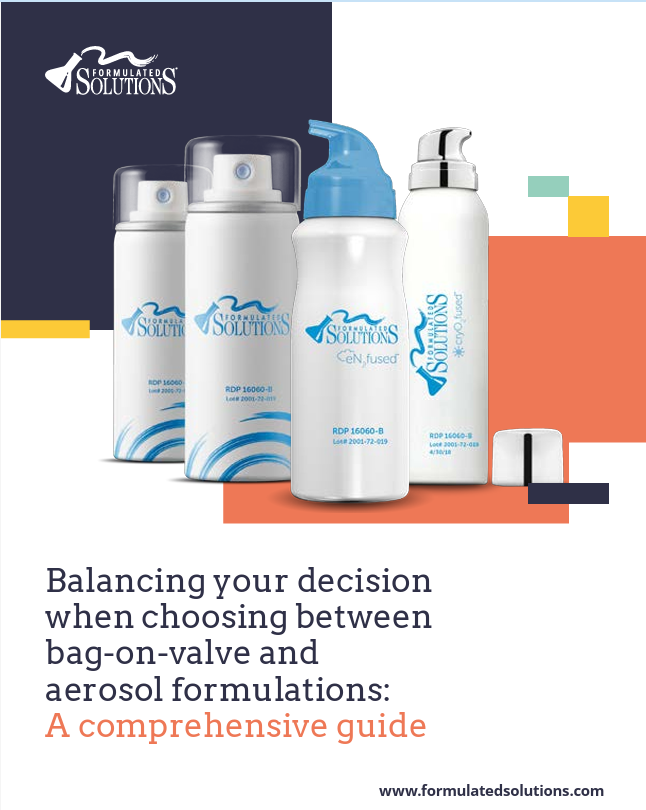
Balancing your decision when choosing between Bag-on-Valve and aerosol formulations
A comprehensive guide to the product purity, dispensing performance, cost and regulatory factors that should drive your container closure system decision.
Executive summary
Choosing the right pressurized container closure system is a critical decision that can significantly impact product success.
Aerosols are a popular, well-established solution that offer versatility and cost-effectiveness, while also delivering a consistent spray pattern throughout the product's life cycle.
Alternatively, Bag-on-Valve (BoV) systems are renowned for maintaining product purity and enabling complete evacuation. Their design facilitates 360-degree spraying, which is particularly beneficial for products used on hard-to-reach areas like the back or scalp, or for individuals with limited mobility.
In this whitepaper, Scott Martz, I&D Principal Packaging Scientist, and Scott Carpenter, Vice President, Marketing and Partner Innovation at Formulated Solutions, delve into the unique characteristics of aerosol and BoV systems, exploring the key considerations to help you confidently select the optimal solution and deliver impact with every action.
Container closure systems for pressurized dispensing
In the competitive consumer health, cosmetics, personal care and medical device landscapes, product packaging is more than just a container; it's an opportunity to optimize product performance, enhance brand perception and leave a lasting impression on users. For pressurized product dispensing, the fundamental choice typically lies between two container closure systems: BoV and traditional aerosol.
Aerosol systems
Aerosol systems are a well-established and versatile approach to product delivery, widely utilized across consumer and industrial sectors for products such as pharmaceutical inhalers, anti-fungal sprays, hemorrhoid sprays, hair growth foams, topical medications, sunscreens and shaving creams. Their effectiveness stems from a precisely engineered pressurized mechanism capable of transforming liquids into fine mists, foams or targeted streams.
At the core of an aerosol system lies a metal or plastic container, designed to withstand internal pressures ranging from 15–150 psig, housing a carefully formulated blend of product (the substance being dispensed) and propellant (a liquefied gas, typically butane, propane or isobutane). Each spray lowers the pressure inside the container, but some liquid propellant turns into gas, bringing the pressure back up for the next spray.
Aerosol components
- Can: the robust vessel, purpose-built to withstand high pressure.
- Valve: ensures hermetic sealing and controlled product release.
- Dip tube: facilitates smooth product flow to the valve assembly.
- Actuator: gives the user precise control — mist, jet or foam.
- Formula concentrate: optimized for maximum performance and stability.
- Propellant: the driving force behind product delivery.
Bag-on-Valve components
- Bag-on-Valve: a multi-layer laminate bag hermetically seals the product, welded to a precision valve.
- Product: liquids and viscous products such as gels, creams and ointments.
- Propellant: inert gases such as nitrogen or compressed air, captured between bag and canister.
- Actuator: delivers a precise and uniform product stream or spray.
- Can: an outer metal container providing a barrier against light, oxygen and contaminants.
Bag-on-valve systems
BoV is an innovative packaging system used across consumer and industrial sectors for products including sterile saline nasal sprays, topical analgesics, sunscreen formulas, hydrogels and whipped lotions. Their unique design makes them an ideal choice for both liquid and viscous products.
At the heart of a BoV system lies a metal or plastic container, typically aluminum or PET, within which a flexible, multi-layer laminate bag or plastic pouch serves as the product reservoir. This bag is welded to a specialized valve, isolating the product from the propellant and forming a hermetic seal. The propellant, typically compressed air or nitrogen, is introduced into the space between the bag and the container wall, acting as the driving force for product expulsion.
Pressing the actuator activates the valve, opening a pathway for the product to escape. The pressurized propellant exerts force on the flexible bag, squeezing it and propelling the product upward through the valve and out of the nozzle. As product is dispensed, the bag gradually collapses, with flow controlled through the actuator orifice size — enabling controlled delivery and maintaining spray characteristics over the life of the product.
Key considerations when choosing between BoV and aerosol
The choice between these two technologies is rarely straightforward, demanding a comprehensive evaluation of several key factors: product purity and compatibility, dispensing performance, cost and regulatory considerations.
1. Product purity and compatibility
Maintaining the purity and stability of a product is non-negotiable, particularly in healthcare, where patient safety is paramount. Key considerations include:
- Sealing and sterility: hermetic seals create an impermeable barrier against external contamination, protecting against microbes, oxygen and other environmental contaminants. Where sterility is paramount, the ability to sterilize the product in the can post-filling is a distinct advantage.
- Material compatibility: container, valve, gasket and seal materials must be carefully evaluated for their potential to interact with the formulation — reactive ingredients like peroxides can degrade components or cause pressure build-up.
- Oxygen sensitivity: for oxidation-sensitive formulations, propellant choice is key — inert gasses like nitrogen minimize the introduction of oxygen into the headspace.
Aerosol considerations
In aerosol products, the formulation directly touches the inside of the container. Products with high salt levels (like antiperspirants) or high acidity/pH can corrode metal parts or react with the aluminum can. Aerosol formulas usually need a pH between 4 and 10 to work well with the container's lining. Propellant type, amount and can strength must also be carefully matched to formulation reactivity. During crimping, most atmospheric air is vacuumed from the headspace, helping support the stability of oxygen-sensitive products.
BoV considerations
A key feature of BoV systems is the complete separation of product and propellant, ensuring exceptional product purity and making the format suitable for even the most sensitive formulas. However, this design necessitates a homogenous product formulation — BoV products lack headspace for agitation, making formulations prone to separation (oil/water mixtures, powder suspensions) unsuitable for BoV. Powders and dry shampoos are generally not compatible with BoV for the same reason.
2. Dispensing performance and user experience
Many factors are critical to user experience, including quick-drying formulations, extended reach for hard-to-reach areas, ease of use for individuals with limited mobility, optimal particle size for effective delivery, and the sensory experience of dispensing — including sound and feel.
Aerosol considerations
Aerosol systems are known for reliable performance and consistent spray patterns, though a small amount of residual product can be difficult to expel, sometimes requiring overfilling to meet label claims. Can orientation matters — holding upright typically gives optimal performance. Aerosols also generally deliver a "colder," drier product experience as the co-dispensed propellant evaporates on exit, which can be advantageous for products like topical analgesics designed to cool before warming.
BoV considerations
BoV systems can achieve near-complete evacuation for many products, particularly thin liquids, coupled with consistent spray patterns and 360-degree spraying — enabling effortless application from any angle, even upside down. Dispensing is quieter than traditional aerosols. Because the propellant (typically nitrogen or compressed air) doesn't significantly cool the product, BoV delivers a "warmer" application — advantageous for sensitive skin or areas where a cold sensation is undesirable.
Real-world example: sunscreen dispensing for different user experiences
Aerosol sunscreens are often combined with lower-cost industry-standard propellants, offering a cost-effective solution for delivering a larger volume of finished product, with a fine mist that provides quick, confident coverage — though the lighter spray can drift in windy conditions. BoV sunscreens typically contain an undiluted formula but deliver a heavier, more targeted spray with larger droplets, reducing drift and enhancing precision. The right choice ultimately comes down to the target user's preferences: speed and cost-effectiveness versus precision and a more substantial feel.
3. Cost considerations
Packaging can represent a significant portion of overall product cost in consumer health, cosmetics, personal care and medical devices, and the potential for a cost advantage depends on the specific product and its needs.
Aerosol
Initial investment involves specialized infrastructure such as a gas house for handling flammable propellants, but subsequent production costs are comparably low since aerosols typically require less expensive packaging components. Specialized valve designs or custom actuators can increase costs, however.
BoV
BoV systems typically rely on packaging components — the multi-layered bag and specialized valve system — that contribute to a higher cost per unit. However, BoV filling equipment is generally less expensive since gas houses and pressure-integrity water bath testing aren't required.
4. Regulatory considerations
Both aerosol and BoV systems must comply with strict regulatory requirements around worker and consumer safety, product quality and efficacy, and environmental protection. Global regulatory guidance includes the Kigali Amendment to the Montreal Protocol (2019) and the EPA's Significant New Alternatives Policy (SNAP) program, alongside regional initiatives like the California Air Resources Board's (CARB) VOC content limits on consumer products.
Some aerosol systems rely on flammable propellants like DME, LPG or difluoroethane (152a), which necessitate stringent safety protocols during manufacturing, filling and storage — specialized gas houses and explosion-proof filling features are required. Beyond manufacturing, ensuring consumer product safety involves careful formulation design, rigorous testing and robust container construction to prevent leaks, ruptures or unintended discharges, plus additional measures like tamper-evident seals and child-resistant packaging where relevant.
Table 1. Key considerations when selecting between BoV and aerosol container closure systems
| Feature | Bag-on-Valve (BoV) | Aerosol |
|---|---|---|
| Product and Propellant | Propellant free. Product stored separately in a flexible inner bag and the outer container. | Mixed within the canister. |
| Propellant | Typically uses compressed air or nitrogen (inert gasses). Not part of the formula — captured between the bag and canister and never dispensed. | Uses liquefied gasses like hydrocarbons or compressed gasses like nitrous oxide or nitrogen. |
| Dispensing Rate | Can dispense nearly 100% of the product. | Typically leaves a residual amount of product in the can. |
| Spray Pattern | Can change as the pressure decreases with product use. | Consistent throughout the product's life cycle. |
| Cost | Can be more expensive to produce due to high component costs. | Generally less expensive to manufacture. |
Weighing up your decision
The choice between aerosol and BoV systems involves a multifaceted assessment of product characteristics, user experience, environmental impact, regulatory compliance and cost considerations. Given the complexities involved, partnering with an experienced formulation and packaging expert can streamline this decision and ensure optimal results for your product.
The ideal partner will possess expertise in both aerosol and BoV technologies, understanding the nuances of each system and providing comprehensive support throughout the product development process, actively seeking to understand your unique needs and goals.
Additionally, a reliable partner should have ample manufacturing capabilities and a proven track record of delivering high-quality products on time and within budget, with a strong understanding of the latest regulatory developments and industry trends.
Ever tried the Formulated Solutions approach?
Delivering excellence since 1999, we specialize in innovative solutions for pharmaceutical, consumer health, personal care and medical device applications. We leverage leading technology to offer increased capacity and faster production times, with four BoV production lines and three aerosol production lines — including a newly validated, fully automated line at our Cleveland, Tennessee facility.
Download the full PDF: Balancing Your Decision: BoV vs. Aerosol whitepaper (PDF)
References
1. ozone.unep.org — Kigali Amendment
2. epa.gov/snap
3. ww2.arb.ca.gov — CARB Consumer Products Program
4. osha.gov — 1910.106